How to write ads that get booked jobs, not just clicks
Want to know how to write Facebook ads for tradesmen that fill the diary, not just the notifications? Here is the structure we use on our own cleaning business: hook, proof photo, plain offer, your area and one clear action.
Free 20-minute call. No contracts pushed. Takes 30 seconds.
Clicks are cheap. Booked jobs are the point
Anyone can get clicks. Pay Meta a few pounds and people will tap your ad. The question is whether they ring back, answer your message and say yes to a quote.
That is how to write Facebook ads for tradesmen that work: write for the booked job, not for the click. Every line of the ad should help the right homeowner say "that is for me", and help the wrong one scroll past.
We run an exterior cleaning business as well as a marketing team. We write and test ads on our own business first, because a weak ad costs us real jobs. This guide is the structure we use, with three example ads written fresh from our own cleaning creative.
Our own roof cleaning ad ran at £20 a day for 2 weeks. It produced 38 leads at £7.42 each, and those leads turned into £8,450 of booked roof cleaning jobs. That is our result on our own business, not a promise for yours. But the ad followed the structure below, and you can copy it.
Our own roof cleaning ad on Facebook and Instagram, £20 a day for 2 weeks.
If you would rather have it written and run for you, see our Facebook and Instagram ads service.
The five-part ad structure
Every ad we write for service businesses has the same five parts. Miss one and the ad leaks money.
1. Hook
One line that makes a local homeowner stop. Place or problem first.
2. Proof photo
A real job from your own phone. Before and after if you have it.
3. Plain offer
What you do and what they get, in words a ten-year-old would follow.
4. Where you cover
Towns or postcodes. It filters out people you cannot reach.
5. One action
One button. Get a quote. Not three choices and a link to your homepage.
Notice what is missing. No company history, no list of every service, no clever pun. The ad has one job: get the right person to fill in a short form. Everything else can wait until the call.
Write the five parts in that order, then read it out loud. If you run out of breath, cut it.
Hooks that stop the scroll
You have about a second. A homeowner is flicking past photos of friends and football. The first line decides whether your ad is seen or skipped.
Four hook formulas that work for local service businesses:
Name the place
Driveways in Chelmsford looking tired? The town in the first line tells locals this is for them.
Name the problem
Moss on your roof? Green patio? Gutters overflowing? Say what they are already looking at.
Lead with the offer
Free roof moss check this month. A plain, specific offer gives people a reason to act now.
Use the season
Get your garden ready before spring. Timely ads feel relevant, not pushy.
What a good hook is not
It is not your company name. It is not "Quality service you can trust". Everyone says that, so nobody reads it. A hook is specific: a place, a problem, an offer or a moment in the year.
Match the hook to the job
Urgent trades, like plumbing, heating and locksmithing, should lead with speed and the area. Planned, visual trades, like cleaning or landscaping, can lead with the problem or the transformation. See how this plays out for landscaping and gardening businesses, where seasonal hooks matter.
Photos: real jobs beat stock every time
The photo does more work than the words. It is the first thing the eye lands on, and it is the proof.
A real photo of a real job tells a homeowner three things at once: you do the work, you do it locally, and you are not a faceless lead-selling site. A stock image tells them none of that.
What makes a good job photo
- Taken in daylight, in focus, with the job clearly visible
- Before and after, side by side, if the change is dramatic
- Your van, your kit or your team in shot, so people see who turns up
- A normal street or driveway, so it feels like their neighbourhood
- Shot portrait or square for phones, with the subject in the middle
Beauty and wellness work the same way
The same rule holds when the service is a person, not a property. For salons and beauty businesses, real finished work, a clean treatment room and a friendly face beat a glossy stock model. Clients are choosing someone to trust with their appearance.
Keep text off the image
Put the words in the ad copy and the headline, not over the photo. A busy image looks like an advert, and people scroll past adverts. A clean job photo looks like a post.
The offer and the area
An offer is not a discount. It is a clear reason to act now. The best ones for local trades are small and specific.
Good offers for a service business
- A free quote or free survey
- A free check, such as a moss or damp check
- Slots this month, with the area named
- A seasonal prompt, like getting a garden ready
Why the area matters
Always say where you cover. It does two things. Locals feel the ad is aimed at them. And people outside your area scroll on, which saves you paying for leads you can never serve.
Targeting does the same job in the background. When we run Facebook and Instagram ads for trades, we set them to your postcodes, then name the towns in the copy so both sides agree.
Do not promise what you cannot deliver
Leave out "cheapest", "guaranteed" and "same-day" unless you can really do it. A promise you miss costs you the review as well as the job.
Lead forms that filter time-wasters
A lead form lets someone enquire without leaving Facebook or Instagram. There is no page to load and no website to squint at on a small screen. That is why it works for local trades.
The risk is volume without quality. An easy form is easy to fill in by accident, so you can end up with leads who never answer. Three small changes fix most of it.
1. Add one qualifying question
Ask one thing that only a real customer will answer. "What needs cleaning: roof, driveway or windows?" or "What is your postcode?" works well. It slows the tyre-kickers down and gives you something to open the call with.
2. Keep the form short
Name, mobile number and the qualifying question. Every extra field loses people. You can collect the rest on the phone.
3. Say what happens next
Tell them: "We will message you on WhatsApp within the hour." It sets expectations and lifts the number who answer.
Three annotated example ads
These are fresh examples written for our own exterior cleaning services, using the structure above. Business names are placeholders. Copy the thinking, not the words.
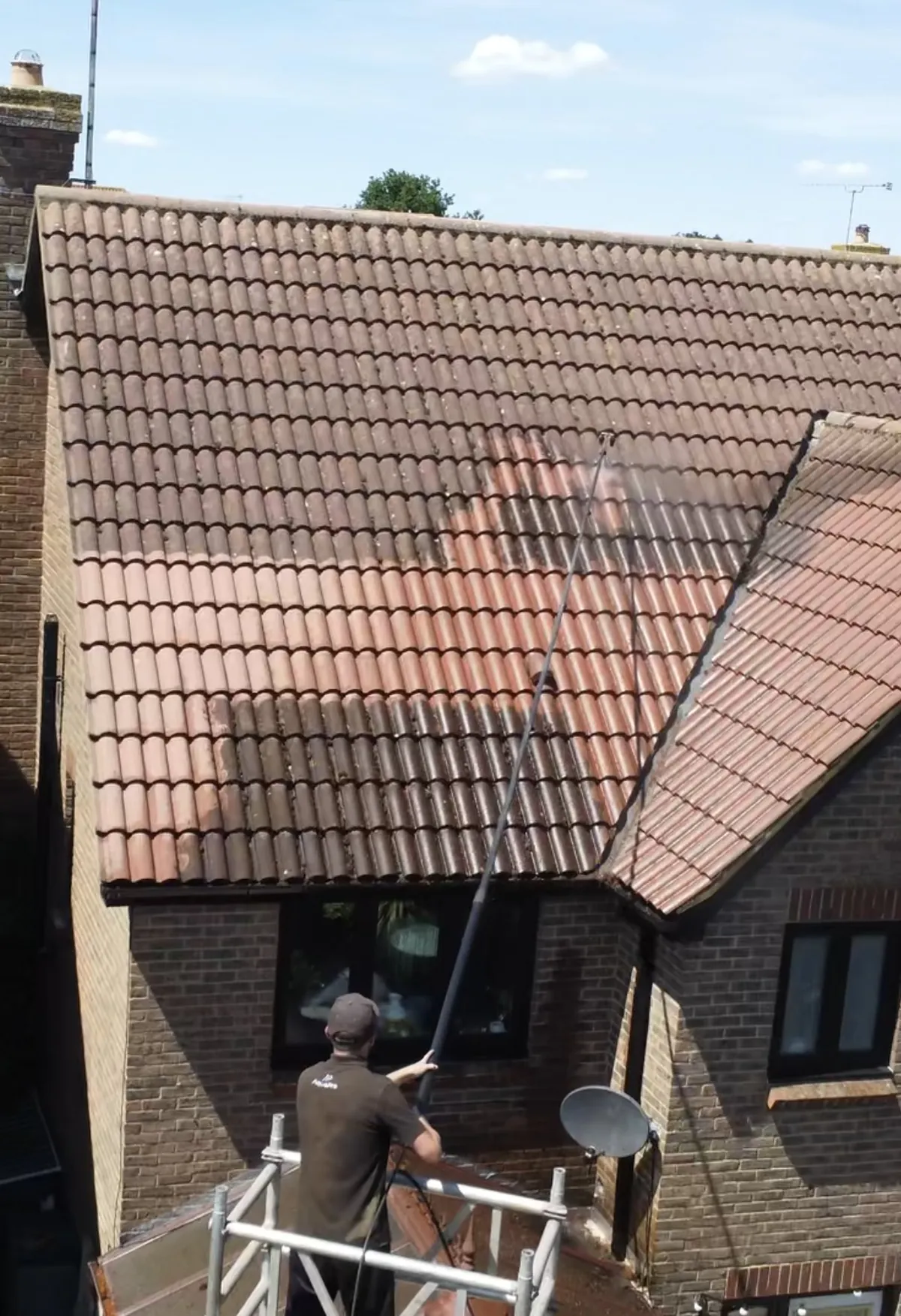
Example 1: the problem hook
A roof is the hardest job to sell, so this one starts with what the homeowner can already see.
- Hook: the problem first, so a homeowner with moss recognises their own roof.
- Photo: our own team on a real roof, not a render.
- Offer: a free quote, with the area named so out-of-area people scroll on.
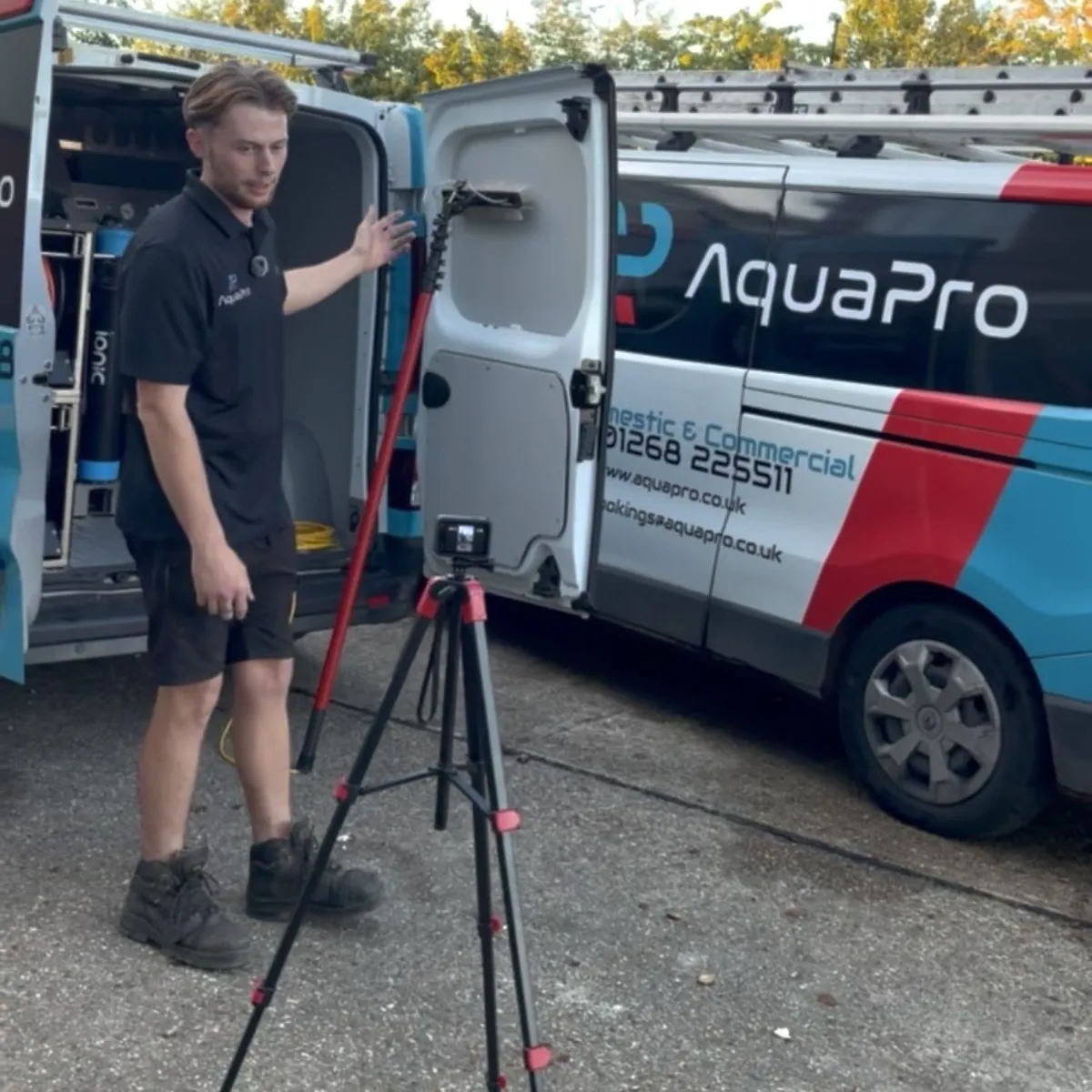
Example 2: the question hook
A short question, a local area and one clear offer.
- Hook: a question the reader answers in their head before they have finished reading.
- Photo: our own team and van on a real street, so people see who will turn up.
- Offer: one specific thing, a free quote, with a clear next step.
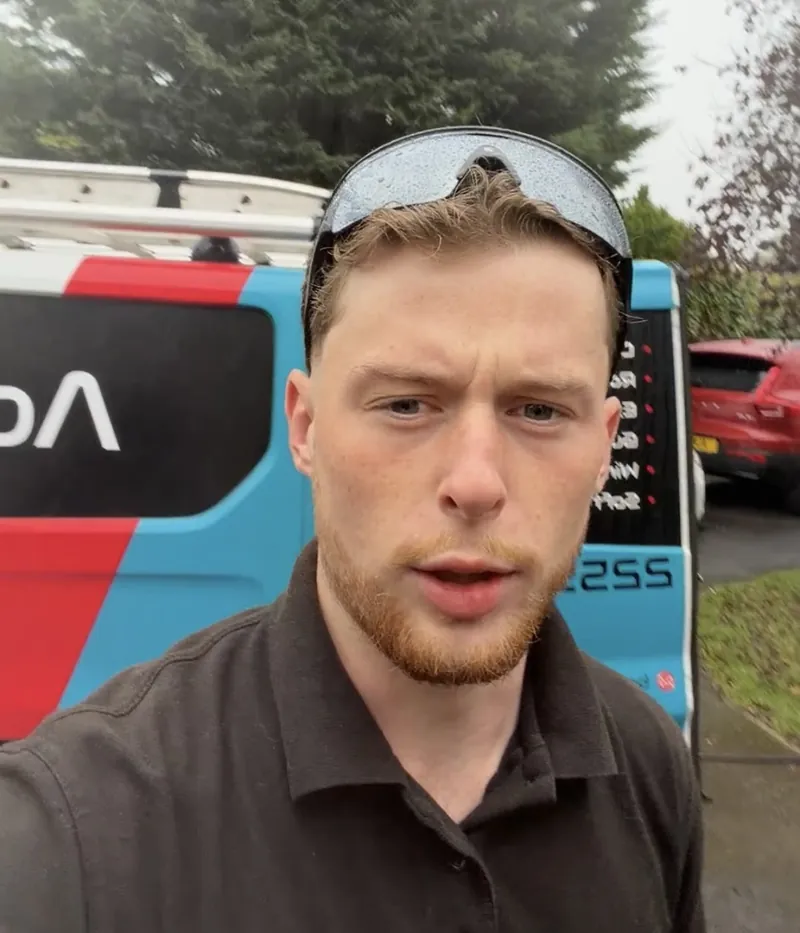
Example 3: the trust hook
People let window cleaners onto their property, so this one leads with who turns up.
- Hook: leads with a result, then the offer, then where we cover.
- Photo: a real face from our own team, because a homeowner is letting a stranger near their house.
- Offer: tied to a time frame, so there is a reason to ask today.
What do they share? One idea each, a real photo, a named area and one button. Not one of them tries to sell everything we do.
Mistakes that waste money
We have made most of these ourselves. Here is what to watch for, and what to do instead.
| Do | Do not | |
|---|---|---|
| Photo | A real job, shot in daylight, ideally before and after | A polished stock image of a smiling worker |
| Opening line | Names the problem or the town | Starts with your company name and a slogan |
| Offer | One clear thing, like a free quote or free check | A list of every service you offer |
| Area | The towns you actually cover | No area, or the whole country |
| Action | One button that opens a short form | Several links, a phone number and a website |
Judging on clicks and likes
Likes pay no bills. Judge each ad on leads and, more importantly, on booked jobs. Our guide to Facebook ads budgets for trades explains how to work back from job value.
Changing everything at once
If you rewrite the hook, photo and offer in one go, you will not know which one helped. Change one thing, wait, then change the next.
Sending people to a slow homepage
A homepage asks the visitor to work out what to do. A lead form asks for three things. Choose the second unless you have a page built just for that ad.
Replying slowly
Good copy that brings leads you answer the next day is wasted. Speed matters as much as the ad.
Never refreshing the ad
People see the same ad again and again, and results tend to fade. Add a new photo or hook every few weeks. See the real results from our own ads, including the roof campaign above, and browse our other marketing guides for service businesses.